
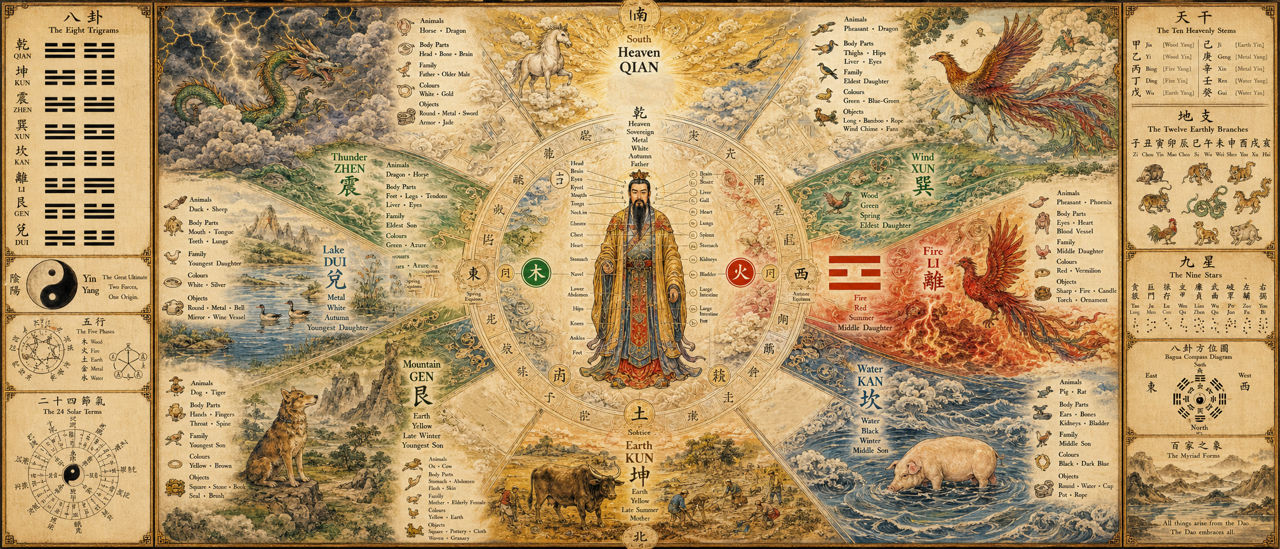

Part One
Only after there were Heaven [Qian, Pure Yang, Hexagram 1] and Earth [Kun, Pure Yin, Hexagram 2] were the myriad things produced from them. What fills Heaven and Earth is nothing other than the myriad things. This is why Qian and Kun are followed by Zhun [Birth Throes, Hexagram 3]. Zhun here signifies repletion.
Zhun is when things are first born. {H.K: Zhun signifies when “the hard and the soft begin to interact,”1 thus it is “when things are first born.”2} When things begin life, they are sure to be covered [the literal meaning of meng—i.e., encapsulated in membranes, eggs, or seeds]. This is why Zhun is followed by Meng [Juvenile Ignorance, Hexagram 4]. Meng here indicates juvenile ignorance, that is, the immature state of things. When things are in their immature state, one cannot fail to nourish them. This is why Meng is followed by Xu [Waiting, Hexagram 5]. Xu here indicates the dao3 of food and drink [i.e., nourishment taken while waiting]. Food and drink necessarily involve Song [Contention, Hexagram 6]. This is why Xu is followed by Song. {H.K: As soon as things have life, they are provided with a proprietary instinct. It is in consequence of their having this proprietary instinct that strife arises.}
When there is contention, there is sure to be an arising of the masses. This is why Song is followed by Shi [The Army, Hexagram 7]. An army as such is a mass of people. A mass of people necessarily involves closeness. This is why Shi is followed by Bi [Closeness, Hexagram 8]. {H.K: If the masses arise but do not close ranks, there will be no reason for strife to cease. People have to feel friendly and close to each other before they can achieve peace.} Closeness as such means “a bringing together.” Bringing together has to involve domestication. This is why Bi is followed by Xiaoxu [Lesser Domestication, Hexagram 9]. {H.K: Bi does not belong to the Dao of the great thoroughfare.4 Thus it only involves what individuals have domesticated in order to take care of themselves. As this is domestication that derives from mere closeness, it is called “Lesser Domestication,” something that cannot happen on a grand scale.} Only after things have been domesticated can there be propriety. This is why Xiaoxu is followed by Lü [Treading, Hexagram 10]. {H.K: Treading here means “propriety.” Propriety is the means by which one uses things in a suitable way. Thus, once things are domesticated, they are then ready for use, and, when they are put to use, this must be done with propriety.5} It is by this treading that Tai [Peace, Hexagram 11] occurs. Only then will there be security. This is why Lü is followed by Tai.
Tai [Peace] means “smooth going.” Things cannot forever go smoothly. This is why Tai is followed by Pi [Obstruction, Hexagram 12]. Things cannot forever be obstructed. This is why Pi is followed by Tongren [Fellowship, Hexagram 13]. {H.K: When obstruction occurs, people think about interaction or cooperation [tong], and everyone begins to share the same goal. Thus they go forth bonded in fellowship, brought together without conscious deliberation.} When one shares fellowship with others, things are sure to yield themselves to him. This is why Tongren is followed by Dayou [Great Holdings, Hexagram 14]. When one’s holdings are great, he must not let himself become satiated. This is why Dayou is followed by Qian [Modesty, Hexagram 15]. To have great holdings and yet be capable of modesty means that one must be content. This is why Qian is followed by Yu [Contentment, Hexagram 16].
When there is contentment, there will be a following. {H.K: One whose actions are based on compliance [with the natural order of things]6 is someone whom the masses will follow.} This is why Yu is followed by Sui [Following, Hexagram 17]. One who gets people to follow him by making them happy inevitably will have problems. This is why Sui is followed by Gu [Ills to Be Cured, Hexagram 18]. Gu here means “problems.” Only when one has had problems can he grow great. {H.K: Enterprises that allow one to achieve greatness originate from such problems.} This is why Gu is followed by Lin [Overseeing, Hexagram 19]. Lin here means “to become great.”7
Only after a thing becomes great can it be viewed. This is why Lin is followed by Guan [Viewing, Hexagram 20]. Only after something can be viewed is there the possibility to come together with it. This is why Guan is followed by Shihe [Bite Together, Hexagram 21]. {H.K: When it is viewed, a thing becomes differentiated, and this is just the moment to come together with it.} The he [in Shihe] means he [unite, i.e., join the jaws together]. But things may not be just recklessly united and left at that! This is why Shihe is followed by Bi [Elegance, Hexagram 22]. Bi here means “adornment.” {H.K: When things are brought together, one must adorn them in order to groom their external appearances.} Adornment will become pervasive only after it has been pushed to the limit, but at that it will become exhausted. {H.K: When adornment has reached its ultimate limit, the real substance of a thing perishes.} This is why Bi is followed by Bo [Peeling, Hexagram 23]. Bo here means “peel off.”
Just as things cannot remain exhausted forever, so with Bo [Peeling]: when they reach all the way to the top, they then return to the bottom.8 This is why Bo is followed by Fu [Return, Hexagram 24]. With such a return, there is freedom from errancy. This is why Fu is followed by Wuwang [No Errancy, Hexagram 25]. Only when there is no errancy can there be domestication. This is why Wuwang is followed by Daxu [Great Domestication, Hexagram 26].
Only after things have been domesticated can nourishment be had. This is why Daxu is followed by Yi [Nourishment, Hexagram 27]. Yi here means “yang” [to nourish]. If there is no nourishment, there can be no action. This is why Yi is followed by Daguo [Major Superiority, Hexagram 28]. {H.K: If nourishment does not occur, one will be incapable of action, but if nourishment reaches superior proportions, one will be amply prepared for it.} One cannot stay forever in a state of superiority. This is why Daguo is followed by [Xi]Kan [(Constant) Sink Hole, Hexagram 29]. Kan here indicates a pit. {H.K: One whose superiority knows no limits will encounter a pitfall.} Once so entrapped, there is sure to be something to catch hold of. This is why Kan is followed by Li [Cohesion, Hexagram 30]. Li here means “li” [clinging]. {H.K: When something reaches its ultimate point, it undergoes change, so when such entrapment reaches its limit, it is converted into something to which one can cling.}
Part Two
Only after there were Heaven and Earth were there the myriad things. Only after there were the myriad things were there male and female. Only after there were male and female were there husband and wife. Only after there were husband and wife were there father and child. Only after there were father and child were there sovereign and minister. Only after there were sovereign and minister were there superiors and subordinates. Only after there were superiors and subordinates did propriety and righteousness have a medium in which to operate. {H.K: This addresses the concept underlying Xian [Reciprocity, Hexagram 31]. In general, what Providing the Sequence of the Hexagrams brings to light does not extend to the arcane source of the Changes, for it merely follows the sequence of the hexagrams and relies on the sequence to clarify what the hexagrams mean. Xian [Reciprocity] consists of a soft trigram above and a hard trigram below. “The two kinds of material force [qi] stimulate and respond and so join together.”9 Of all the images of husband and wife, none is more beautiful than this! Nothing in the Dao of human relationships is greater than the relationship between husband and wife. It is due to it that we have the earnestness and civility between father and son [and in the other relationships]. As this profoundly states the concept underlying Xian, it elevates the relationship between husband and wife to progenitor of all human relationships, and so one does not attach these remarks to Li [Cohesion]. Earlier Confucians regarded the text from Qian [Pure Yang, Hexagram 1] to Li [Cohesion, Hexagram 30] as the first half of the Classic of Changes and to be concerned with the Dao of Heaven and that from Xian [Reciprocity, Hexagram 31] to Weiji [Ferrying Incomplete, Hexagram 64] as the second half and to be concerned with the Dao of Mankind. In the Changes, the six lines form the hexagrams in such a way that the three powers [Heaven, Earth, and Man] all have to be complete in them. These replicate change and transformation by intricately weaving Heaven and Man together,10 so how could it be possible to shunt apart the Dao of Heaven and the affairs of mankind to a first and a second half of the work! To do so is to safeguard what the text says to the neglect of seeking what it means, an error that put them far wide of the mark!} The Dao of husband and wife cannot fail to be long enduring. This is why Xian is followed by Heng [Perseverance, Hexagram 32]. Heng here means “long enduring.”
Things cannot long abide where they are located. This is why Heng is followed by Dun [Withdrawal, Hexagram 33]. Dun here means “retreat.” {H.K: In the Dao of husband and wife, perseverance is esteemed, but a creature cannot exercise such perseverance about the place in which to abide, for its suitability goes up and down with worldly conditions; there are times when one should withdraw.} Things cannot be in withdrawal forever. {H.K: Withdrawal is the means by which the noble man distances himself from petty men. Only by withdrawing will he later prevail, so how could he remain in such a state forever! If he were to do so, petty men would thrive and superior men would daily diminish in number.} This is why Dun is followed by Dazhuang [Great Strength, Hexagram 34]. {H.K: With the waxing of yang, there is a waning of yin. Here we have the ascendancy of the Dao of the noble man.} Things cannot remain strong forever. This is why Dazhuang is followed by Jin [Advance, Hexagram 35]. {H.K: Jin means “to advance using soft methods.”} Jin here means “to advance.” {H.K: Although this is “advance using soft methods,” the main thing is that this is still “advance.”} Going forward is sure to involve getting wounded. This is why Jin is followed by Mingyi [Suppression of the Light, Hexagram 36]. {H.K: When the sun reaches mid-sky, it starts its decline, and it is at full strength when it suffers eclipse.} Yi here means “wounding.” When one is wounded abroad, he is sure to return to his own home. This is why Mingyi is followed by Jiaren [The Family, Hexagram 37]. {H.K: When one is wounded abroad, he is sure to return to convalesce at home.}
When the Dao of the family is completely exhausted, there is sure to be discord. {H.K: If a family is very intimate and loving, its failure will be due to a neglect of integrity and honor. This is why Jiaren in conceptual terms only advocates strictness and reverence. However, “if the music is overwhelming, this will lead to laxity, but if decorum is overwhelming, this will lead to estrangement.”11 As Jiaren places exclusive emphasis on strictness, failure here is sure to stem from discord.} This is why Jiaren is followed by Kui [Contrariety, Hexagram 38]. Kui here means “discord.” When there is contrariety, there is sure to be adversity. This is why Kui is followed by Jian [Adversity, Hexagram 39]. Jian here means “trouble.” Things cannot remain in trouble. This is why Jian is followed by Xie [Release, Hexagram 40]. Xie here means “huan” [go slow, take it easy].
With relaxation, there is sure to be neglect. This is why Xie is followed by Sun [Diminution, Hexagram 41]. If diminution keeps going on and does not stop, this is sure to lead to increase. This is why Sun is followed by Yi [Increase, Hexagram 42]. If increase keeps going on and does not stop, there is sure to be a breakthrough. {H.K: If something increases without ever stopping, surfeit will result. As a result of this, “there is sure to be a breakthrough.”} This is why Yi is followed by Kuai [Resolution, Hexagram 43]. Kuai here means “breakthrough.” With resolution, one is sure to encounter opportunity. {H.K: If one uses rightness to break through or resolve evil, one will be sure to encounter happy opportunities.} This is why Kuai is followed by Gou [Encounter, Hexagram 44]. Gou here means “to meet.”
Only after things meet is there a gathering. This is why Gou is followed by Cui [Gathering, Hexagram 45]. Cui here means “to gather.” To gather and build upward is called “climbing.” This is why Cui is followed by Sheng [Climbing, Hexagram 46]. If climbing goes on and does not stop, there is sure to be impasse. This is why Sheng is followed by Kun [Impasse, Hexagram 47]. When impasse is met with above, there is sure to be a turnabout downward. This is why Kun is followed by Jing [The Well, Hexagram 48].
The Dao of wells cannot help but involve radical change. {H.K: After a long time, a well becomes fouled, so then one should renovate it completely.} This is why Jing is followed by Ge [Radical Change, Hexagram 49].
For effecting a radical change in things, there is nothing as good as a caldron. This is why Ge is followed by Ding [The Caldron, Hexagram 50]. {H.K: “Ge [Radical Change] means ‘get rid of the old’; Ding [The Caldron] means ‘take up the new.’”12 Once one has gotten rid of the old, one ought to “fashion ceremonial vessels and establish laws”13 in order to gain control over the new state of affairs. The caldron is the means by which one brings harmony to the living creatures and keeps them well regulated.14 It is the vessel associated with the accomplishment of a new order, and this is why one takes this image from it.15 For taking charge of such vessels, no one is more appropriate than the eldest son. This is why Ding is followed by Zhen [Quake, Hexagram 51].16 Zhen here signifies movement. Things cannot be kept in a state of movement forever but eventually are brought to a stop. This is why Zhen is followed by Gen [Restraint, Hexagram 52]. Gen here means “to stop.” Things cannot remain in a state of Restraint forever. This is why Gen is followed by Jian [Gradual Advance, Hexagram 53]. Jian here means “to advance.” Advance is sure to involve being restored to one’s home. This is why Jian is followed by Guimei [Marrying Maiden, Hexagram 54].17 When one manages to be restored to his proper place, he is sure to enjoy greatness. This is why Guimei is followed by Feng [Abundance, Hexagram 55]. Feng here means “to grow great.”}
When one exhausts the potential to grow great, he is sure to lose his position. This is why Feng is followed by Lü [The Wanderer, Hexagram 56]. When one is a wanderer, he has nowhere to be taken in. This is why Lü is followed by Sun [Compliance, Hexagram 57]. {H.K: If “one is a wanderer” and “has nowhere to be taken in,” he will only succeed in gaining entrance and egress by using compliance.} Compliance provides entrance. Only after gaining such entry will one find delight in it. This is why Sun is followed by Dui [Joy, Hexagram 58]. Dui here means “delight.” Having found such delight, one now disperses it. This is why Dui is followed by Huan [Dispersion, Hexagram 59]. {H.K: Though delightful, one may not enter into biased relationships. This is why one here ought to disperse.} Huan [Dispersion] involves separation or estrangement. {H.K: Huan means “to start out and go along with facility free of all impediment.” As a result, one here utterly transcends all restraints and does not turn back, but this inevitably leads to estrangement.}
People cannot remain in a state of estrangement forever. This is why Huan is followed by Jie [Control, Hexagram 60]. {H.K: If in the handling of affairs there is this control, it will be maintained together by people, who then will not become estranged and break up.} Once there is such control, people will have trust in it. This is why Jie is followed by Zhongfu [Inner Trust, Hexagram 61]. {H.K: Fu means “trust.” Once control already exists, one ought then to have trust in it and so maintain it.} One who enjoys such trust will be sure to put it to use. This is why Zhongfu is followed by Xiaoguo [Minor Superiority, Hexagram 62]. {H.K: If one just works at maintaining this trust, he will neglect the Dao of “practicing constancy without being stubborn.”18 Nevertheless, with this trust he should achieve some superiority.} This is why it is called “Minor Superiority.” Once there is superiority over creatures [the masses, i.e., “subjects”], one is sure to ferry them [across troubles, i.e., “rescue them”]. {H.K: It is by conduct superior in its respect and by decorum superior in its economy that one can reform the world and encourage good customs. This is how one gains the wherewithal to become a ferry.} This is why Xiaoguo is followed by Jiji [Ferrying Complete, Hexagram 63]. Creatures [the masses, i.e., “subjects”] must never be hard-pressed. This is why Jiji is followed by Weiji [Ferrying Incomplete, Hexagram 64], with which the hexagrams come to an end. {H.K: If one must resort to purposeful action to try to ferry creatures [across troubles], that means that one has already made them hard-pressed. When creatures are hard-pressed, opposition occurs, and when one’s achievements peak, chaos starts to ensue. How could anyone ever serve as a ferry that way? “This is why Jiji is followed by Weiji [Ferrying Incomplete].”}
Only after there were Heaven [Qian, Pure Yang, Hexagram 1] and Earth [Kun, Pure Yin, Hexagram 2] were the myriad things produced from them. What fills Heaven and Earth is nothing other than the myriad things. This is why Qian and Kun are followed by Zhun [Birth Throes, Hexagram 3]. Zhun here signifies repletion.
Zhun is when things are first born. {H.K: Zhun signifies when “the hard and the soft begin to interact,”1 thus it is “when things are first born.”2} When things begin life, they are sure to be covered [the literal meaning of meng—i.e., encapsulated in membranes, eggs, or seeds]. This is why Zhun is followed by Meng [Juvenile Ignorance, Hexagram 4]. Meng here indicates juvenile ignorance, that is, the immature state of things. When things are in their immature state, one cannot fail to nourish them. This is why Meng is followed by Xu [Waiting, Hexagram 5]. Xu here indicates the dao3 of food and drink [i.e., nourishment taken while waiting]. Food and drink necessarily involve Song [Contention, Hexagram 6]. This is why Xu is followed by Song. {H.K: As soon as things have life, they are provided with a proprietary instinct. It is in consequence of their having this proprietary instinct that strife arises.}
When there is contention, there is sure to be an arising of the masses. This is why Song is followed by Shi [The Army, Hexagram 7]. An army as such is a mass of people. A mass of people necessarily involves closeness. This is why Shi is followed by Bi [Closeness, Hexagram 8]. {H.K: If the masses arise but do not close ranks, there will be no reason for strife to cease. People have to feel friendly and close to each other before they can achieve peace.} Closeness as such means “a bringing together.” Bringing together has to involve domestication. This is why Bi is followed by Xiaoxu [Lesser Domestication, Hexagram 9]. {H.K: Bi does not belong to the Dao of the great thoroughfare.4 Thus it only involves what individuals have domesticated in order to take care of themselves. As this is domestication that derives from mere closeness, it is called “Lesser Domestication,” something that cannot happen on a grand scale.} Only after things have been domesticated can there be propriety. This is why Xiaoxu is followed by Lü [Treading, Hexagram 10]. {H.K: Treading here means “propriety.” Propriety is the means by which one uses things in a suitable way. Thus, once things are domesticated, they are then ready for use, and, when they are put to use, this must be done with propriety.5} It is by this treading that Tai [Peace, Hexagram 11] occurs. Only then will there be security. This is why Lü is followed by Tai.
Tai [Peace] means “smooth going.” Things cannot forever go smoothly. This is why Tai is followed by Pi [Obstruction, Hexagram 12]. Things cannot forever be obstructed. This is why Pi is followed by Tongren [Fellowship, Hexagram 13]. {H.K: When obstruction occurs, people think about interaction or cooperation [tong], and everyone begins to share the same goal. Thus they go forth bonded in fellowship, brought together without conscious deliberation.} When one shares fellowship with others, things are sure to yield themselves to him. This is why Tongren is followed by Dayou [Great Holdings, Hexagram 14]. When one’s holdings are great, he must not let himself become satiated. This is why Dayou is followed by Qian [Modesty, Hexagram 15]. To have great holdings and yet be capable of modesty means that one must be content. This is why Qian is followed by Yu [Contentment, Hexagram 16].
When there is contentment, there will be a following. {H.K: One whose actions are based on compliance [with the natural order of things]6 is someone whom the masses will follow.} This is why Yu is followed by Sui [Following, Hexagram 17]. One who gets people to follow him by making them happy inevitably will have problems. This is why Sui is followed by Gu [Ills to Be Cured, Hexagram 18]. Gu here means “problems.” Only when one has had problems can he grow great. {H.K: Enterprises that allow one to achieve greatness originate from such problems.} This is why Gu is followed by Lin [Overseeing, Hexagram 19]. Lin here means “to become great.”7
Only after a thing becomes great can it be viewed. This is why Lin is followed by Guan [Viewing, Hexagram 20]. Only after something can be viewed is there the possibility to come together with it. This is why Guan is followed by Shihe [Bite Together, Hexagram 21]. {H.K: When it is viewed, a thing becomes differentiated, and this is just the moment to come together with it.} The he [in Shihe] means he [unite, i.e., join the jaws together]. But things may not be just recklessly united and left at that! This is why Shihe is followed by Bi [Elegance, Hexagram 22]. Bi here means “adornment.” {H.K: When things are brought together, one must adorn them in order to groom their external appearances.} Adornment will become pervasive only after it has been pushed to the limit, but at that it will become exhausted. {H.K: When adornment has reached its ultimate limit, the real substance of a thing perishes.} This is why Bi is followed by Bo [Peeling, Hexagram 23]. Bo here means “peel off.”
Just as things cannot remain exhausted forever, so with Bo [Peeling]: when they reach all the way to the top, they then return to the bottom.8 This is why Bo is followed by Fu [Return, Hexagram 24]. With such a return, there is freedom from errancy. This is why Fu is followed by Wuwang [No Errancy, Hexagram 25]. Only when there is no errancy can there be domestication. This is why Wuwang is followed by Daxu [Great Domestication, Hexagram 26].
Only after things have been domesticated can nourishment be had. This is why Daxu is followed by Yi [Nourishment, Hexagram 27]. Yi here means “yang” [to nourish]. If there is no nourishment, there can be no action. This is why Yi is followed by Daguo [Major Superiority, Hexagram 28]. {H.K: If nourishment does not occur, one will be incapable of action, but if nourishment reaches superior proportions, one will be amply prepared for it.} One cannot stay forever in a state of superiority. This is why Daguo is followed by [Xi]Kan [(Constant) Sink Hole, Hexagram 29]. Kan here indicates a pit. {H.K: One whose superiority knows no limits will encounter a pitfall.} Once so entrapped, there is sure to be something to catch hold of. This is why Kan is followed by Li [Cohesion, Hexagram 30]. Li here means “li” [clinging]. {H.K: When something reaches its ultimate point, it undergoes change, so when such entrapment reaches its limit, it is converted into something to which one can cling.}
Part Two
Only after there were Heaven and Earth were there the myriad things. Only after there were the myriad things were there male and female. Only after there were male and female were there husband and wife. Only after there were husband and wife were there father and child. Only after there were father and child were there sovereign and minister. Only after there were sovereign and minister were there superiors and subordinates. Only after there were superiors and subordinates did propriety and righteousness have a medium in which to operate. {H.K: This addresses the concept underlying Xian [Reciprocity, Hexagram 31]. In general, what Providing the Sequence of the Hexagrams brings to light does not extend to the arcane source of the Changes, for it merely follows the sequence of the hexagrams and relies on the sequence to clarify what the hexagrams mean. Xian [Reciprocity] consists of a soft trigram above and a hard trigram below. “The two kinds of material force [qi] stimulate and respond and so join together.”9 Of all the images of husband and wife, none is more beautiful than this! Nothing in the Dao of human relationships is greater than the relationship between husband and wife. It is due to it that we have the earnestness and civility between father and son [and in the other relationships]. As this profoundly states the concept underlying Xian, it elevates the relationship between husband and wife to progenitor of all human relationships, and so one does not attach these remarks to Li [Cohesion]. Earlier Confucians regarded the text from Qian [Pure Yang, Hexagram 1] to Li [Cohesion, Hexagram 30] as the first half of the Classic of Changes and to be concerned with the Dao of Heaven and that from Xian [Reciprocity, Hexagram 31] to Weiji [Ferrying Incomplete, Hexagram 64] as the second half and to be concerned with the Dao of Mankind. In the Changes, the six lines form the hexagrams in such a way that the three powers [Heaven, Earth, and Man] all have to be complete in them. These replicate change and transformation by intricately weaving Heaven and Man together,10 so how could it be possible to shunt apart the Dao of Heaven and the affairs of mankind to a first and a second half of the work! To do so is to safeguard what the text says to the neglect of seeking what it means, an error that put them far wide of the mark!} The Dao of husband and wife cannot fail to be long enduring. This is why Xian is followed by Heng [Perseverance, Hexagram 32]. Heng here means “long enduring.”
Things cannot long abide where they are located. This is why Heng is followed by Dun [Withdrawal, Hexagram 33]. Dun here means “retreat.” {H.K: In the Dao of husband and wife, perseverance is esteemed, but a creature cannot exercise such perseverance about the place in which to abide, for its suitability goes up and down with worldly conditions; there are times when one should withdraw.} Things cannot be in withdrawal forever. {H.K: Withdrawal is the means by which the noble man distances himself from petty men. Only by withdrawing will he later prevail, so how could he remain in such a state forever! If he were to do so, petty men would thrive and superior men would daily diminish in number.} This is why Dun is followed by Dazhuang [Great Strength, Hexagram 34]. {H.K: With the waxing of yang, there is a waning of yin. Here we have the ascendancy of the Dao of the noble man.} Things cannot remain strong forever. This is why Dazhuang is followed by Jin [Advance, Hexagram 35]. {H.K: Jin means “to advance using soft methods.”} Jin here means “to advance.” {H.K: Although this is “advance using soft methods,” the main thing is that this is still “advance.”} Going forward is sure to involve getting wounded. This is why Jin is followed by Mingyi [Suppression of the Light, Hexagram 36]. {H.K: When the sun reaches mid-sky, it starts its decline, and it is at full strength when it suffers eclipse.} Yi here means “wounding.” When one is wounded abroad, he is sure to return to his own home. This is why Mingyi is followed by Jiaren [The Family, Hexagram 37]. {H.K: When one is wounded abroad, he is sure to return to convalesce at home.}
When the Dao of the family is completely exhausted, there is sure to be discord. {H.K: If a family is very intimate and loving, its failure will be due to a neglect of integrity and honor. This is why Jiaren in conceptual terms only advocates strictness and reverence. However, “if the music is overwhelming, this will lead to laxity, but if decorum is overwhelming, this will lead to estrangement.”11 As Jiaren places exclusive emphasis on strictness, failure here is sure to stem from discord.} This is why Jiaren is followed by Kui [Contrariety, Hexagram 38]. Kui here means “discord.” When there is contrariety, there is sure to be adversity. This is why Kui is followed by Jian [Adversity, Hexagram 39]. Jian here means “trouble.” Things cannot remain in trouble. This is why Jian is followed by Xie [Release, Hexagram 40]. Xie here means “huan” [go slow, take it easy].
With relaxation, there is sure to be neglect. This is why Xie is followed by Sun [Diminution, Hexagram 41]. If diminution keeps going on and does not stop, this is sure to lead to increase. This is why Sun is followed by Yi [Increase, Hexagram 42]. If increase keeps going on and does not stop, there is sure to be a breakthrough. {H.K: If something increases without ever stopping, surfeit will result. As a result of this, “there is sure to be a breakthrough.”} This is why Yi is followed by Kuai [Resolution, Hexagram 43]. Kuai here means “breakthrough.” With resolution, one is sure to encounter opportunity. {H.K: If one uses rightness to break through or resolve evil, one will be sure to encounter happy opportunities.} This is why Kuai is followed by Gou [Encounter, Hexagram 44]. Gou here means “to meet.”
Only after things meet is there a gathering. This is why Gou is followed by Cui [Gathering, Hexagram 45]. Cui here means “to gather.” To gather and build upward is called “climbing.” This is why Cui is followed by Sheng [Climbing, Hexagram 46]. If climbing goes on and does not stop, there is sure to be impasse. This is why Sheng is followed by Kun [Impasse, Hexagram 47]. When impasse is met with above, there is sure to be a turnabout downward. This is why Kun is followed by Jing [The Well, Hexagram 48].
The Dao of wells cannot help but involve radical change. {H.K: After a long time, a well becomes fouled, so then one should renovate it completely.} This is why Jing is followed by Ge [Radical Change, Hexagram 49].
For effecting a radical change in things, there is nothing as good as a caldron. This is why Ge is followed by Ding [The Caldron, Hexagram 50]. {H.K: “Ge [Radical Change] means ‘get rid of the old’; Ding [The Caldron] means ‘take up the new.’”12 Once one has gotten rid of the old, one ought to “fashion ceremonial vessels and establish laws”13 in order to gain control over the new state of affairs. The caldron is the means by which one brings harmony to the living creatures and keeps them well regulated.14 It is the vessel associated with the accomplishment of a new order, and this is why one takes this image from it.15 For taking charge of such vessels, no one is more appropriate than the eldest son. This is why Ding is followed by Zhen [Quake, Hexagram 51].16 Zhen here signifies movement. Things cannot be kept in a state of movement forever but eventually are brought to a stop. This is why Zhen is followed by Gen [Restraint, Hexagram 52]. Gen here means “to stop.” Things cannot remain in a state of Restraint forever. This is why Gen is followed by Jian [Gradual Advance, Hexagram 53]. Jian here means “to advance.” Advance is sure to involve being restored to one’s home. This is why Jian is followed by Guimei [Marrying Maiden, Hexagram 54].17 When one manages to be restored to his proper place, he is sure to enjoy greatness. This is why Guimei is followed by Feng [Abundance, Hexagram 55]. Feng here means “to grow great.”}
When one exhausts the potential to grow great, he is sure to lose his position. This is why Feng is followed by Lü [The Wanderer, Hexagram 56]. When one is a wanderer, he has nowhere to be taken in. This is why Lü is followed by Sun [Compliance, Hexagram 57]. {H.K: If “one is a wanderer” and “has nowhere to be taken in,” he will only succeed in gaining entrance and egress by using compliance.} Compliance provides entrance. Only after gaining such entry will one find delight in it. This is why Sun is followed by Dui [Joy, Hexagram 58]. Dui here means “delight.” Having found such delight, one now disperses it. This is why Dui is followed by Huan [Dispersion, Hexagram 59]. {H.K: Though delightful, one may not enter into biased relationships. This is why one here ought to disperse.} Huan [Dispersion] involves separation or estrangement. {H.K: Huan means “to start out and go along with facility free of all impediment.” As a result, one here utterly transcends all restraints and does not turn back, but this inevitably leads to estrangement.}
People cannot remain in a state of estrangement forever. This is why Huan is followed by Jie [Control, Hexagram 60]. {H.K: If in the handling of affairs there is this control, it will be maintained together by people, who then will not become estranged and break up.} Once there is such control, people will have trust in it. This is why Jie is followed by Zhongfu [Inner Trust, Hexagram 61]. {H.K: Fu means “trust.” Once control already exists, one ought then to have trust in it and so maintain it.} One who enjoys such trust will be sure to put it to use. This is why Zhongfu is followed by Xiaoguo [Minor Superiority, Hexagram 62]. {H.K: If one just works at maintaining this trust, he will neglect the Dao of “practicing constancy without being stubborn.”18 Nevertheless, with this trust he should achieve some superiority.} This is why it is called “Minor Superiority.” Once there is superiority over creatures [the masses, i.e., “subjects”], one is sure to ferry them [across troubles, i.e., “rescue them”]. {H.K: It is by conduct superior in its respect and by decorum superior in its economy that one can reform the world and encourage good customs. This is how one gains the wherewithal to become a ferry.} This is why Xiaoguo is followed by Jiji [Ferrying Complete, Hexagram 63]. Creatures [the masses, i.e., “subjects”] must never be hard-pressed. This is why Jiji is followed by Weiji [Ferrying Incomplete, Hexagram 64], with which the hexagrams come to an end. {H.K: If one must resort to purposeful action to try to ferry creatures [across troubles], that means that one has already made them hard-pressed. When creatures are hard-pressed, opposition occurs, and when one’s achievements peak, chaos starts to ensue. How could anyone ever serve as a ferry that way? “This is why Jiji is followed by Weiji [Ferrying Incomplete].”}
Notes
1. The quote is from Hexagram 3, Zhun (Birth Throes), Commentary on the Judgments.
2. This and all subsequent text set off in this manner is commentary by Han Kangbo.
3. When Dao is capitalized, it indicates the Cosmic Dao, the Moral Dao, the Dao of the noble man, the Way; dao, on the other hand, indicates the way things are or operate for ordinary, lesser, or even evil events and processes—for instance, the “dao of the petty man.”
4. “Great thoroughfare” translates datong, as it appears in the Zhuangzi, where it is used to mean the Dao on a grand scale, the Great Dao in the perfection of its operation. As such, the expression in other texts—including the Changes and its commentaries—often seems to mean “everything (right) goes smoothly.”
5. Lü is the modern pronunciation; the duyin or reading pronunciation is li, which makes it a homonym of li, propriety (they were also apparently homonyms in antiquity). This may be the simple basis of identifying “treading” with “propriety,” though lü (treading) as a noun also means shoe or foot cover, and one theory is that such foot covers indicate propriety. The Song dynasty commentator on the Changes, Xiang Anshi, offers another suggestion: “‘Treading’ is not directly equivalent to ‘propriety,’ but where one should tread is never outside the bounds of propriety. If it is outside its bounds, it is not a place where one ought to tread.”
6. Following Kong Yingda’s comments.
7. The Song era commentator Xiang Anshi attempts to explain the connection between “oversee” and “great”: “Lin is not to be glossed simply as ‘great,’ for ‘great’ here refers to those above overseeing those below, or the great overseeing the small. Whenever Lin [Overseeing] is involved, it always concerns the affairs of the great, and this is why the term great is used to explain it here. Only if Lin means greatness the way Feng [Abundance, Hexagram 55] means greatness, could one truly gloss it with the term great as such.”
8. Hexagram 23, Bo, consists of one positive line in the top, sixth place and five negative lines; Hexagram 24, Fu (Return), consists of one positive line in the bottom, first place and five negative lines. As a pair, these two hexagrams form a continuum in which the one positive line from the top of Hexagram 23 “returns” to the bottom of Hexagram 24.
9. See Hexagram 31, Xian (Reciprocity), Commentary on the Judgments.
10. This alludes to a passage in section ten of the Commentary on the Appended Phrases, Part One: “It is by interspersing numbers that change proceeds. The numbers are combined in the various ways, which exhaust all aspects of change, and, in consequence, the hexagrams form the patterns of Heaven and Earth.”
11. Liji (Book of rites), 37: 11b.
12. See the Hexagrams in Irregular Order.
13. See Wang Bi’s commentary on Hexagram 50, Ding, the Judgment.
14. “Brings harmony and keeps well regulated” translates heji, which often means “blend ingredients”—as in cooking or concocting medicines. However, it is likely that Han is using heji in another sense here, as it appears for instance in the Xunzi: “[The petty man] does not have it in him to follow the lead of an enlightened sovereign above, nor does he have it in him to bring harmony to the common folk and keep them well regulated below.”
15. Ding are the bronze ceremonial vessels that were often cast to commemorate events in ancient China, including enfeoffment of nobles, successions or appointments of individuals to noble rank and office, ascensions to rulership, etc., all of which signify new beginnings. As a ceremonial vessel, the ding also symbolized stewardship of the state. Although Han, following Wang Bi, interprets Ding in these terms, later commentators (Cheng Yi and Zhu Xi, for instance) emphasize instead the fact that the ding are cooking vessels—the “renewal” they bring about is the new (cooked) form of the raw food prepared in them.
16. Zhen (Quake) consists of a doubling of the trigram Zhen, also Quake. It is associated with the Eldest Son. See section ten of Explaining the Trigrams.
17. Here “Marrying Maiden” might be construed as “Maiden who restores herself [goes] to her [husband’s] home.”
18. Lunyu (Analects) 15:36: “The noble man practices constancy without being stubborn.”
2. This and all subsequent text set off in this manner is commentary by Han Kangbo.
3. When Dao is capitalized, it indicates the Cosmic Dao, the Moral Dao, the Dao of the noble man, the Way; dao, on the other hand, indicates the way things are or operate for ordinary, lesser, or even evil events and processes—for instance, the “dao of the petty man.”
4. “Great thoroughfare” translates datong, as it appears in the Zhuangzi, where it is used to mean the Dao on a grand scale, the Great Dao in the perfection of its operation. As such, the expression in other texts—including the Changes and its commentaries—often seems to mean “everything (right) goes smoothly.”
5. Lü is the modern pronunciation; the duyin or reading pronunciation is li, which makes it a homonym of li, propriety (they were also apparently homonyms in antiquity). This may be the simple basis of identifying “treading” with “propriety,” though lü (treading) as a noun also means shoe or foot cover, and one theory is that such foot covers indicate propriety. The Song dynasty commentator on the Changes, Xiang Anshi, offers another suggestion: “‘Treading’ is not directly equivalent to ‘propriety,’ but where one should tread is never outside the bounds of propriety. If it is outside its bounds, it is not a place where one ought to tread.”
6. Following Kong Yingda’s comments.
7. The Song era commentator Xiang Anshi attempts to explain the connection between “oversee” and “great”: “Lin is not to be glossed simply as ‘great,’ for ‘great’ here refers to those above overseeing those below, or the great overseeing the small. Whenever Lin [Overseeing] is involved, it always concerns the affairs of the great, and this is why the term great is used to explain it here. Only if Lin means greatness the way Feng [Abundance, Hexagram 55] means greatness, could one truly gloss it with the term great as such.”
8. Hexagram 23, Bo, consists of one positive line in the top, sixth place and five negative lines; Hexagram 24, Fu (Return), consists of one positive line in the bottom, first place and five negative lines. As a pair, these two hexagrams form a continuum in which the one positive line from the top of Hexagram 23 “returns” to the bottom of Hexagram 24.
9. See Hexagram 31, Xian (Reciprocity), Commentary on the Judgments.
10. This alludes to a passage in section ten of the Commentary on the Appended Phrases, Part One: “It is by interspersing numbers that change proceeds. The numbers are combined in the various ways, which exhaust all aspects of change, and, in consequence, the hexagrams form the patterns of Heaven and Earth.”
11. Liji (Book of rites), 37: 11b.
12. See the Hexagrams in Irregular Order.
13. See Wang Bi’s commentary on Hexagram 50, Ding, the Judgment.
14. “Brings harmony and keeps well regulated” translates heji, which often means “blend ingredients”—as in cooking or concocting medicines. However, it is likely that Han is using heji in another sense here, as it appears for instance in the Xunzi: “[The petty man] does not have it in him to follow the lead of an enlightened sovereign above, nor does he have it in him to bring harmony to the common folk and keep them well regulated below.”
15. Ding are the bronze ceremonial vessels that were often cast to commemorate events in ancient China, including enfeoffment of nobles, successions or appointments of individuals to noble rank and office, ascensions to rulership, etc., all of which signify new beginnings. As a ceremonial vessel, the ding also symbolized stewardship of the state. Although Han, following Wang Bi, interprets Ding in these terms, later commentators (Cheng Yi and Zhu Xi, for instance) emphasize instead the fact that the ding are cooking vessels—the “renewal” they bring about is the new (cooked) form of the raw food prepared in them.
16. Zhen (Quake) consists of a doubling of the trigram Zhen, also Quake. It is associated with the Eldest Son. See section ten of Explaining the Trigrams.
17. Here “Marrying Maiden” might be construed as “Maiden who restores herself [goes] to her [husband’s] home.”
18. Lunyu (Analects) 15:36: “The noble man practices constancy without being stubborn.”